Showing posts with label saints. Show all posts

Saturday, June 5, 2010

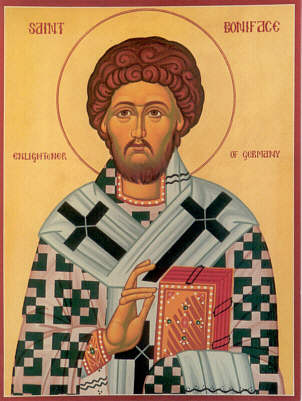
St. Boniface: Apostle to the Germans

Today is the feast day of St. Boniface (754).  This morning while driving to the Airport and listening to the Daily Mass on KBVM, I heard a wonderful homily which introduced me to St. Boniface, the English Benedictine monk who would become "The Apostle to the Germans" (The archived readings and homily can be found here, June 5th).

In order to understand the life and actions of St. Boniface, we first need to understand the context into which he was called to proclaim the Gospel.  Boniface went on his first missionary journey to Germany in 719 at the request of Pope Gregory II.  From his biography on www.americancatholic.org, we see that when St. Boniface arrived in Germany. he found that....

Paganism was a way of life. What Christianity he did find had either lapsed into paganism or was mixed with error. The clergy were mainly responsible for these latter conditions since they were in many instances uneducated, lax and questionably obedient to their bishops .... These are the conditions that Boniface was to report in 722 on his first return visit to Rome. The Holy Father instructed him to reform the German Church.
So what were the paganism practices the Germanic people had lapsed into?  According to http://en.wikipedia.org/wiki/Germanic_paganism,

Across the Germanic world, there was some variation in the places where pagans worshipped, however, it was common for sites displaying prominent natural features to be used. Tacitus claimed that the 1st century tribes of Germany did not "confine the gods within walls... but that they worshipped outdoors in sacred woods and groves",[14] and similarly there is evidence from later continental Europe, Anglo-Saxon England and Scandinavia that the pagans worshipped out of doors at "trees, groves, wells, stones, fences and cairns".[15] In some later cases, temples would be built on such sites, the most notable being the Swedish Temple at Uppsala which, according to Adam of Bremen, writing in the 11th century, was built around a grove which was "so holy that each tree is itself regarded as sacred".

According to Tacitus, the Germanic tribes think of temples as unsuitable habitations for gods, and they do not represent them as idols in human shape. Instead of temples, they consecrate woods or groves to individual gods.
So it is clear that pagan worship held created things, trees, nature, as sacred which is evident since the Germanic people of this region worshiped at Thor's Oak, a place of veneration of the Germanic deity Thor, (or Donar), the god of Thunder.

On his return from Rome, in 723, St. Boniface began his efforts to bring the Germanic people to Christ.   To do so, he had to begin by uprooting paganism.  In what might be unimaginable today: 

On his return to Hesse, he decided to try to root out the pagan superstitions which seriously affected the stability of his converts. On a day publicly announced, and in the midst of an awe-struck crowd, Boniface and one or two of his followers attacked with axes Thor's sacred oak. These German tribes, along with many other primitive peoples, were tree-worshipers. Thor, god of thunder, was one of the principal Teutonic deities, and this ancient oak, which stood on the summit of Mt. Gudenberg, was sacred to him. After a few blows, the huge tree crashed to earth, splitting into four parts. The terrified tribesmen, who had expected a punishment to fall instantly on the perpetrators of such an outrage, now saw that their god was powerless to protect even his own sanctuary.
St. Boniface had this sacred oak tree, the tree of pagan worship, felled not because he did not love or appreciate nature and God's Created things, but to dislodge the people from their pagan beliefs and practices so they could come to know and accept Christ. Tradition has it he used the wood from Thor's Oak to build a chapel. The felling of Thor's oak is considered the beginning of the Christianization of Germany.

The site of the original chapel built using the wood of Thor's Oak eventually became the site of the 12-14th century Gothic Cathedral of St. Peter, which stands today in Fritzlar, Germany to this today.  A statue of St. Boniface holding his axe faces the Cathedral

St Boniface was over 70 years old and was spending his final years doing missionary work among some of the early converts who had been drifting back into paganism.  On one of these missionary trips, in 754, he was martyred along with the rest of his party by a band of armed pagans.

St. Boniface, pray for us, that we might never place the good and proper love of nature and created things, above our love of their Creator, our Heavenly Father and his Son, our Lord Jesus Christ.

Photos: http://www.orthodoxengland.org.uk/boniface.htm (1), http://commons.wikimedia.org/wiki/File:Bonifacius_by_Emil_Doepler.jpg (2), http://en.wikipedia.org/wiki/File:Fritzlar_dom_st_peter.jpg (3)

Sunday, November 22, 2009

¡Viva Cristo Rey!

The image to the right is behind one of the side altars of the Shrine of Our Lady of Guadalupe in La Crosse Wisconsin. I had never heard of the person in the picture before our tour guide recounted the story of Blessed Miguel Pro.  It is truly amazing to learn of the heroic faith demonstrated by the Saints in every generation, including our own.  I had no idea that Catholics were persecuted and put to death in Mexico less than 100 years ago.  Father Pro was executed on Nov 23, 1927.  The images below of Blessed Miguel's execution were ordered to be taken by Mexican President Plutarco Elías Calles in order to intimidate Catholics.

One wonderful site on Bl. Miguel Pro tells the story this way:
"Calles wanted the execution to be a "big show" and had instructed his underlings to invite representatives from all the government secretariats, the press, and photographers. His intention was to show the Catholics as groveling cowards. Instead, the photos spoke eloquently of their heroism. After the execution, an attempt was made to recall the photographs, and possession of them became a crime. But the damage had been done -- the world had seen."
This is consistent with the story told by our tour guide at the shrine church.  The guide identified "the press" as the New York Times, who were present to document the event.

Father Miguel kneels in prayer for those about to take his life....
And stands, refuses the blindfold.  Holding his arms out like a cross, he is executed by firing squad. I will not display those images here.
The funeral of Bl. Miguel was clearly NOT the outcome that those who took his life had hoped for.

Bl. Miguel Pro, may the example of your faith strengthen our own. Pray for us that, may we also grow to love Our Lord and his Church more than we love our own lives.

Bl. Miguel Pro was beatified by Pope John Paul II on September 25, 1988.

I do not own the following book yet, but it is on my Christmas list.

Blessed Miguel Pro: 20th Century Mexican Martyr, Ann Ball, TAN Books and Publishers

The movie "For Greater Glory" opens on June 1, 2012, and tells the all but forgotten story of the Cristeros War (1926-1929).

Images:  http://puffin.creighton.edu/jesuit/pro/pro_martyr_01.html

Saturday, October 31, 2009

All Saint Day/ Reformation Sunday


Timothy George, founding dean of Beeson Divinity School, and a senior editor of Christianity Today, writes on Reformation Day over at FIRST THINGS.  He concludes his article by reflecting on the 1999 Lutheran / Catholic Joint Declaration on the Doctrine of Justification (JDDJ), where he writes:

"..convergence on justification does not equal consensus on all aspects of the doctrine of salvation. The framers of the Joint Declaration itself were forced to add an annex to the document delineating unresolved differences on simul iustus et peccator, Luther’s idea that justified believers are at one and the same time sinful and righteous before God. How justification and sanctification are related in the life of the Christian still continues to be debated. On these and many other issues related to authority and ecclesiology, the way forward is not to smudge over deep differences that remain between the two traditions but to acknowledge them openly and to continue to struggle over them together in prayer and in fresh engagement with the Scriptures. The way forward is an ecumenism of conviction, not an ecumenism of accommodation.

Several years ago I was asked to endorse a book by my friend Mark Noll called Is the Reformation Over? I responded by saying that the Reformation is over only to the extent that it succeeded. In fact, in some measure, the Reformation has succeeded, and more within the Catholic Church than in certain sectors of the Protestant world. The triumph of grace in the theology of Luther was—and still is—in the service of the whole Body of Christ. Luther was not without his warts, and we can hardly imagine him canonized as a saint. (Remember: simul iustus et peccator!) But the question Karl Barth asked about him in 1933 is still worth pondering this Reformation Day: “What else was Luther than a teacher of the Christian church whom one can hardly celebrate in any other way but to listen to him?”

As a former Lutheran who has individually healed the Reformation breach as the late Father Neuhaus reflected on long before the JDDJ, I pray that we may grow in true and visible Christian unity and see reconciliation in our lifetimes. As Catholics, we celebrate and remember all the Saints in heaven today.   One of the most meaningful parts of the Mass for me is in Eucharistic Prayer II:

Look with favour on your Church's offering, 
and see the Victim whose death has reconciled us to yourself. 
Grant that we who are nourished by his body and blood, 
may be filled with his Holy Spirit, and become one body, one spirit in Christ. 
May he make us an everlasting gift to you and 
enable us to share in the inheritance of your saints, with 
Mary the virgin Mother of God; with the apostles, the martyrs, 
and all your saints on whose constant intercession we rely for help.
Lord, may this sacrifice which has made our peace with you, 
advance the peace and salvation of all the world. 
Strengthen in faith and love your pilgrim Church on earth; 
your servant, Benedict, our Pope, John our Bishop, and all the 
bishops with the clergy and the entire people your Son has gained for you.
Father, hear the prayers of the family you have gathered
here before you. In mercy and love unite all your children wherever they may be. 
Welcome into your kingdom our departed brothers and sisters, 
and all who have left this world in your friendship. 
We hope to enjoy for ever the vision of your glory, 
through Christ our Lord, from whom all good things come. 
Through him, with him, in him, 
in the unity of the Holy Spirit, 
all glory and honour is yours, almighty Father, 
for ever and ever. 
Amen.

Litany of Saints
Holy Mary Mother of God, Pray for us
St. Joseph, Pray for us
St. Michael, pray for us
St. John the Apostle, pray for us
Ss. Peter and Paul, Pray for us
St. Thérèse of Lisieux, Pray for us
St. Louis de Montfort, Pray for us
St. Francis of Assisi, Pray for us
St. John the Baptist, pray for us
St. Francis de Sales, Pray for us
St. Juan Diego, Pray for us
St. Augustine, Pray for us
St. John Vianney, Pray for us
St. Pius X, Pray for us
St. Anthony of Padua, Pray for us
St. Ignatius of Loyola, Pray for us
St. Maximilian Kolbe, Pray for us
Bl. Kateri Tekakwitha, Pray for us
Bl. Miguel Pro, Pray for us
Bl. Theresa of Calcutta, Pray for us


PICTURE: Torsten Schleese (public domain)

Sunday, October 25, 2009

St. Gianna Beretta Molla


When I first saw this image at one of the side altars in the beautiful Shrine Church at Our Lady of Guadalupe Shrine in La Crosse Wisconsin, I thought it looked somewhat out of place.  It is beautiful, but the central woman is dressed in a modern doctor's uniform.  After a few moments of standing before the painting, there was something vaguely familiar about the story if was portraying.  Then the tour guide began to explain the painting, and of course it is a picture of St. Gianna Beretta Molla, who died only in 1962 and was canonized by Pope John Paul II in 2004.  You can read about the life of St. Gianna here.  A truly heroic modern Saint.  Saint Gianna, Pray for us!